

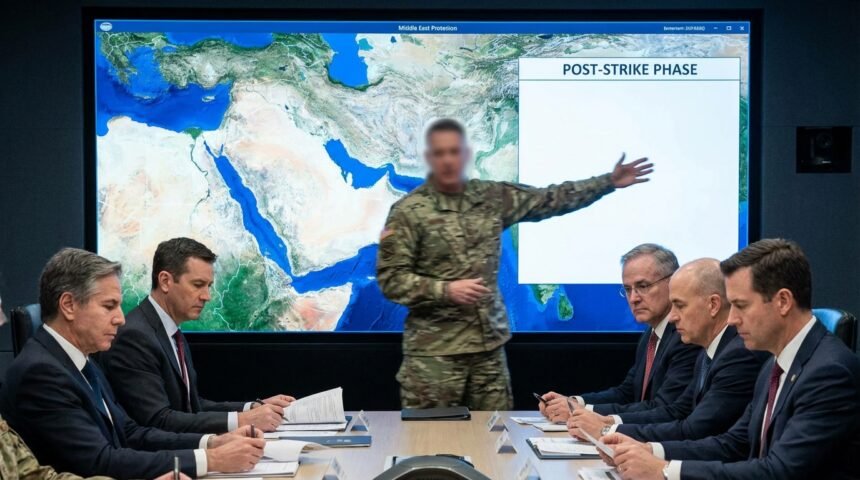
The United States administration under President Donald Trump has come under scrutiny for proceeding with major military action against Iran without articulating a coherent roadmap for the nation’s future governance. According to Financial Times columnist Gideon Rachman, the recent military offensive launched jointly by Washington and Tel Aviv marks a significant departure from previous American interventions in the Middle East, raising fundamental questions about what happens after the bombs stop falling.
Drawing comparisons to the 2001 Afghanistan invasion and the 2003 Iraq War, Rachman notes that while those campaigns were plagued with strategic miscalculations and tragic consequences, they at least included comprehensive plans involving ground force deployment, regime removal, and nation-building initiatives. The current Iranian operation, by contrast, appears to rely exclusively on aerial bombardment to achieve regime change—a strategy without historical precedent or demonstrated viability.
The strikes, which commenced on Saturday, February 28, resulted in the deaths of Supreme Leader Ayatollah Ali Khamenei along with numerous senior military commanders and political figures within Iran’s power structure. Despite this dramatic decapitation of Iranian leadership, the administration has offered no substantive framework for political transition. Trump’s explicit rejection of deploying American ground troops—a decision influenced by casualty concerns and the failed nation-building experiments in Afghanistan and Iraq—leaves the United States committed to an untested approach that banks entirely on air power to catalyze internal political transformation.
In his public statements following the initial strikes, President Trump called upon the Islamic Revolutionary Guard Corps to lay down their weapons and encouraged the Iranian population to “take control of their government.” However, these appeals were notably devoid of practical detail or institutional support mechanisms. Even if factions within Iran’s security apparatus were inclined to abandon the current regime, no alternative authority structure exists to fill the resulting power vacuum. The absence of any organized opposition leadership, transitional governance plan, or international administrative framework leaves Iran facing potential chaos rather than orderly transition.
The strategic ambiguity surrounding post-conflict Iran represents a significant gamble for American foreign policy. Without boots on the ground or a clear political endgame, the administration appears to be wagering that military pressure alone will spontaneously generate a stable, pro-Western government in Tehran. Critics argue this represents wishful thinking rather than strategic planning, potentially creating conditions for prolonged instability, humanitarian crisis, or the emergence of even more radical elements to fill the leadership void left by targeted assassinations of current regime figures.